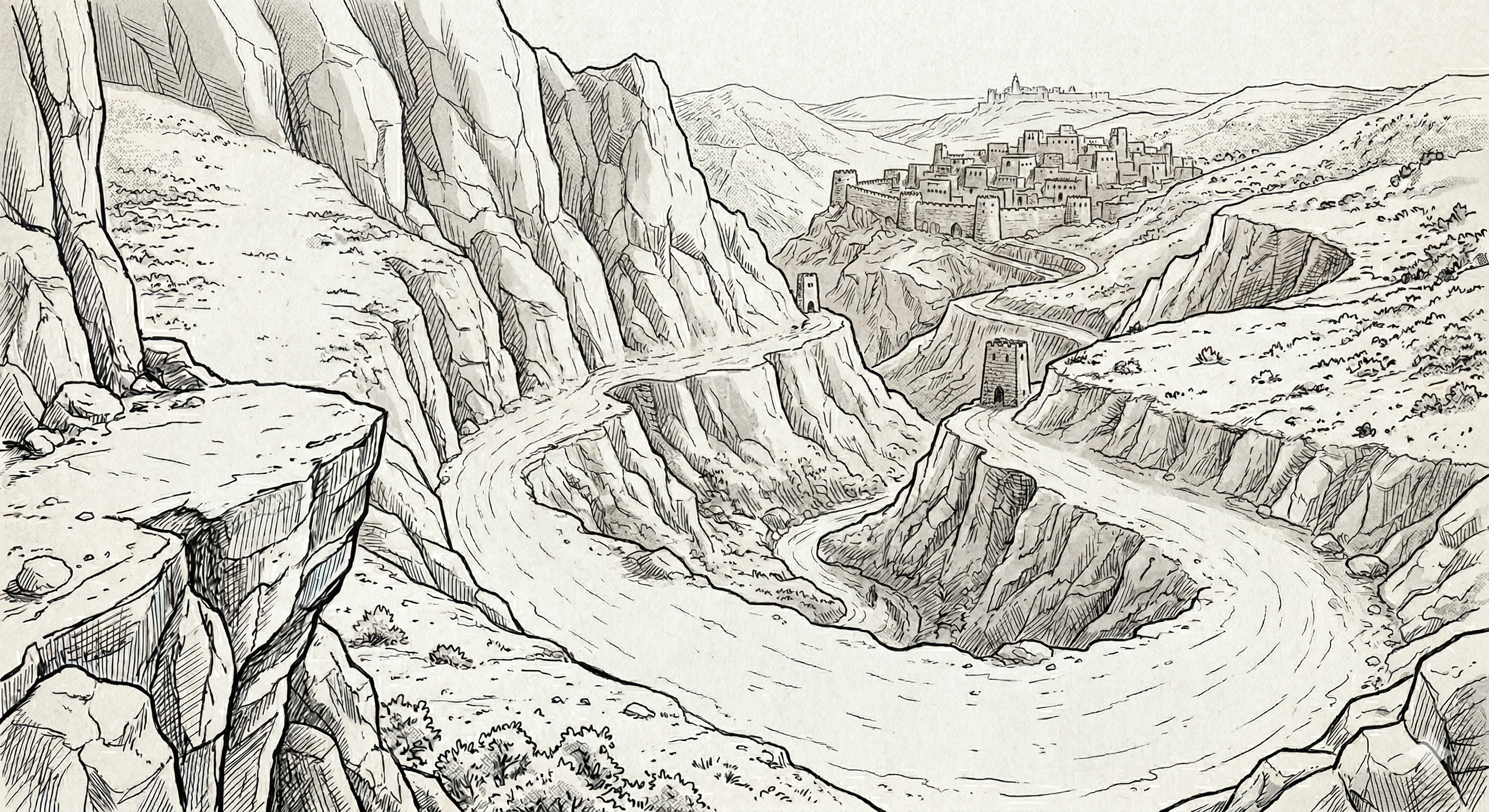
Every civilisation that rose in the subcontinent had to account for the Khyber. It is the seam between worlds — the narrow corridor through which armies, traders, missionaries, refugees, and ideas have moved for at least three thousand years. The subcontinent’s history is, in part, a history of what came through that pass and what it became once it arrived.
For the novel, the Khyber is not just a geographical feature but a recurring pressure. The question of what comes through — and whether it is welcomed, resisted, or absorbed — runs underneath the whole of Book 1.
There is something about the illustration that gets this right: the pass itself is barely visible, a fold in the rock, and the city in the distance seems uncertain whether it is a fortress or an invitation.