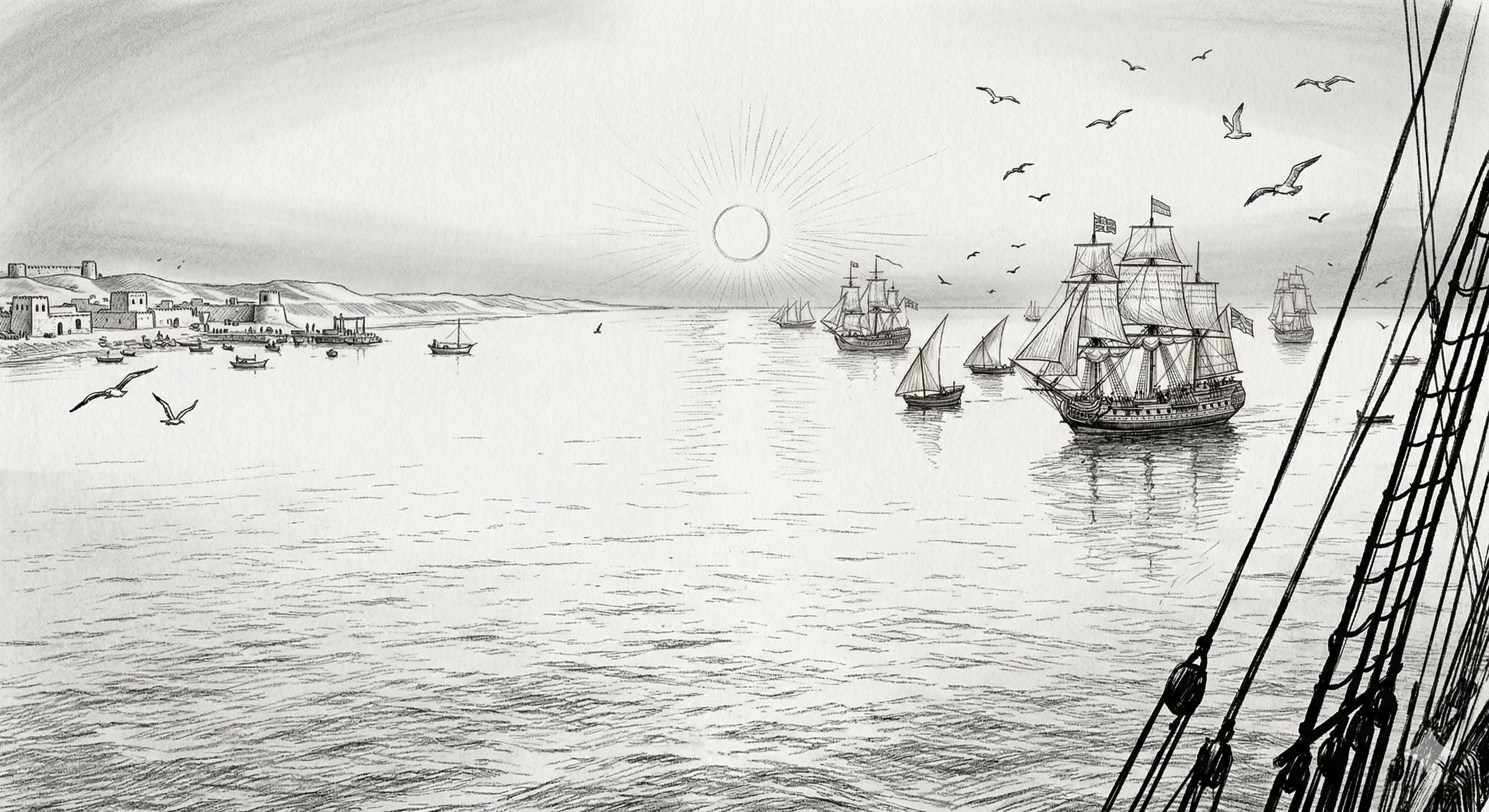
The subcontinent has always faced two directions: inland, toward the Gangetic plain and the passes of the northwest, and outward, toward the sea. The Arabian Sea coast was one of the great trade corridors of the ancient world — connected to the Persian Gulf, to the Red Sea, to East Africa, in patterns of exchange that predate the European age of sail by more than a millennium.
This outward-facing quality is important to the novel. Aryavartha is not a closed world. It is a world in contact — with other civilisations, other systems of knowledge, other ways of understanding what a city or an empire or a person is for. The sea is where that contact arrives.
The novel opens its second chapter on the western coast, in the city of Surat, where a military captain named Jodha watches the horizon from the roof of a fortified tower. The moment the pulse reaches him is one I kept returning to in drafts:
He felt the 432-hertz signal enter through the soles of his boots. A deep, clean vibration that climbed his legs and settled in his chest like a second heartbeat. For a moment, the constant ache in his sword arm eased. For a moment, the horizon looked less like a threat.
The sea in this scene is both a border and a highway. What makes it threatening is also what makes it necessary.