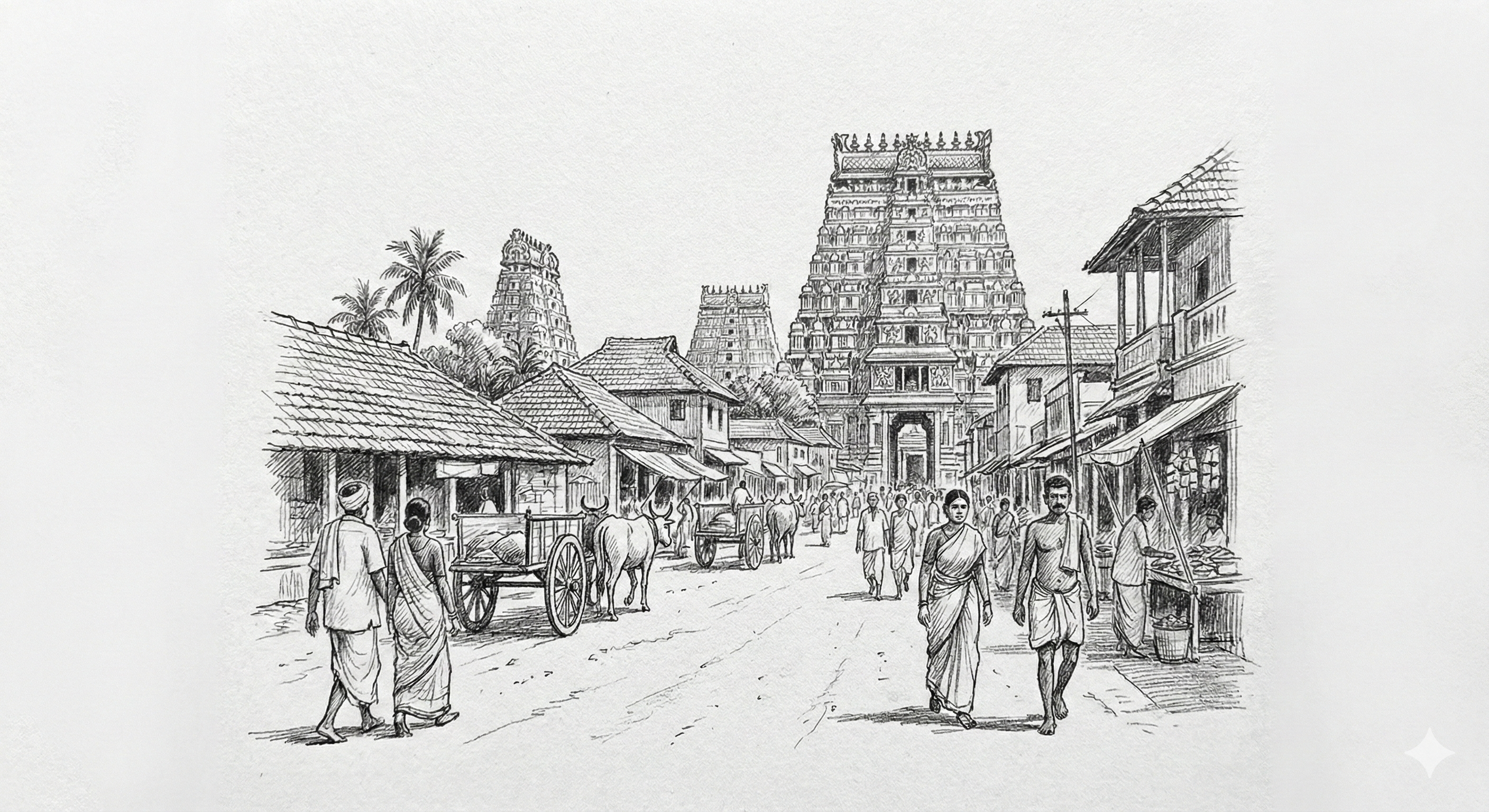
The novel begins in Chidambaram. I chose it because it is one of the oldest continuously functioning temple cities in the world, and because the Nataraja — the dancing Shiva — is the image around which the book’s central metaphor is built. The god dances inside a ring of fire, one foot raised, the cosmos in motion. It is an image of reality as vibration, as rhythm, as something always in the act of becoming.
In the world of the novel, the temple is not only a place of worship. It is infrastructure. The great bronze Nataraja is tuned — literally — to the energy grid that runs beneath the subcontinent. When something is wrong with the grid, the statue feels it first.
This is from the opening chapter:
“This came two hours ago from the Nataraja priests. The great bronze, the dancing Shiva, has developed a hairline crack along the left ankle.”
Vidyut took the tablet. The message was scratched in hurried shorthand: Crack observed at fourth watch. No physical cause. Requesting guidance.
“A resonance crack,” he murmured. “The statue is tuned to the grid. If the grid’s frequency is being disrupted from outside…”
“Then the statue is trying to vibrate at two frequencies at once, and the metal is failing.”
The city itself, in the illustration above, has the quality I was trying to capture in prose: busy, layered, the sacred and the commercial side by side, the gopuram rising above everything as a fixed point in a world that is perpetually in motion.