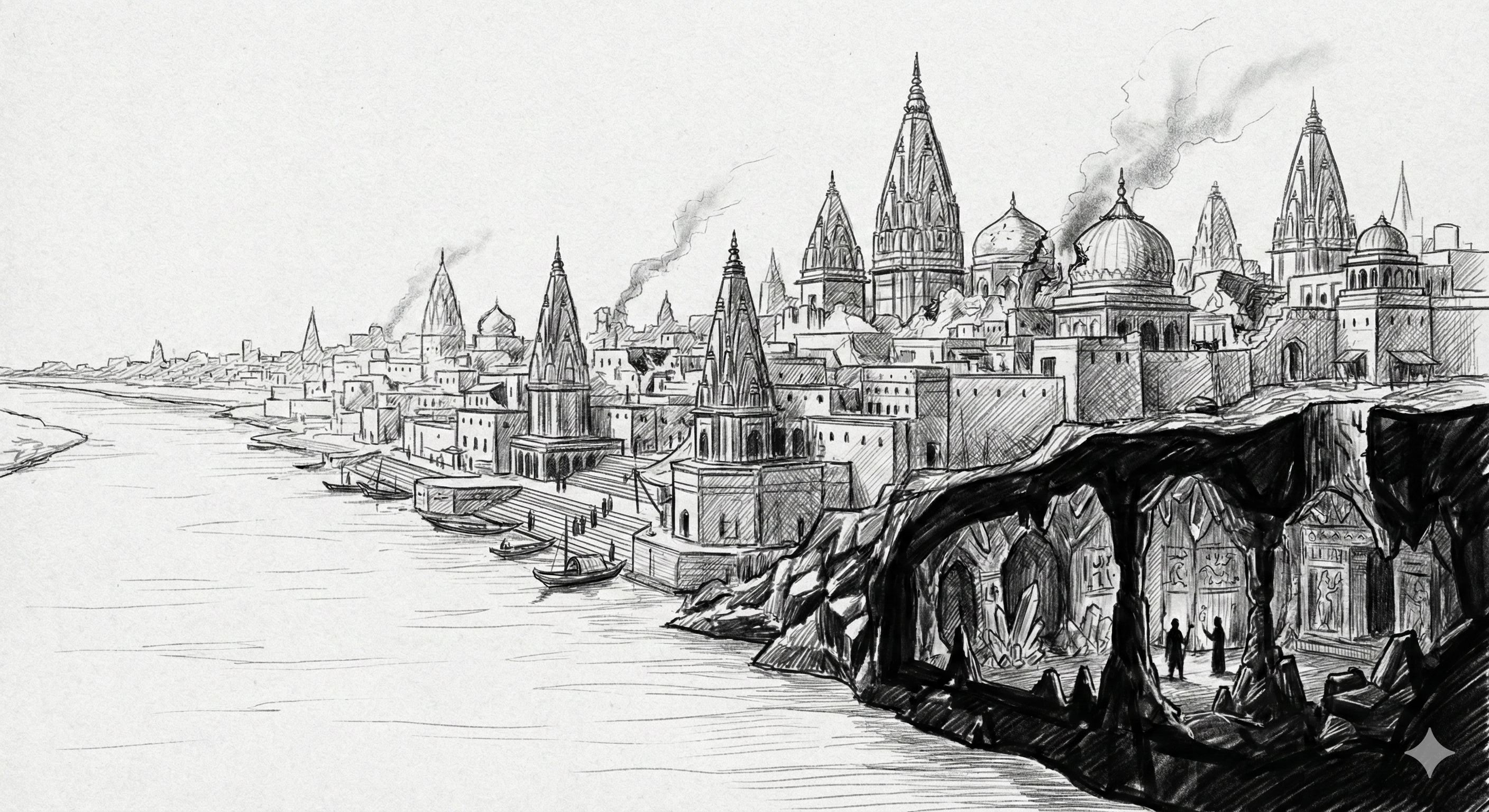
Kannauj is the city at the centre of the subcontinent’s political gravity in the 8th century. Whoever held Kannauj held the argument about who ruled the north. The Rashtrakutas, the Pratiharas, and the Palas fought over it with a dedication that would have been impressive if it weren’t so exhausting — what historians call the Tripartite Struggle, a century of contested sovereignty over a single city on the Ganga plain.
In the novel, Kannauj represents a different kind of danger — not military but informational. It is a city where the energy grid has gone cold, where the ley-lines that connect the subcontinent’s network of knowledge and resonance simply stop. The protagonist Vidyut tests his resonance stone near it:
When he turned it northeast, toward Kannauj, it went cold entirely.
A city that does not appear on the frequency map is a city that has been deliberately removed from it. That absence is itself a kind of statement — and the novel takes it seriously as a threat.
The illustration above shows it from the river: layered, prosperous, river-facing. The city that everyone wants and no one can hold for long.